You can enjoy the National Museum of Korea without trying to see every gallery. For a first visit, choose a period or question that interests you and a few objects to explore, leaving time to read and sit down. Start by separating the free permanent collection from any additional exhibition or booking you may want.
This guide proposes a three-stop route, then shows how to shorten it. It also covers gallery closures checked on 8 September 2026, so you can see which rooms to include in your plan.
Which exhibitions are free?
The museum’s visitor information confirms that the permanent collection is free. Temporary exhibitions can have different admission conditions. The Children’s Museum is free but uses timed reservations, and other group conditions can apply. “Free museum” therefore does not mean that every activity is available without advance arrangements.
For a straightforward first visit, decide whether the permanent collection is enough. If you add an exhibition, read its own dates, price and entry method, then leave enough time to see it. There is no need to add a paid event just because the museum is large.
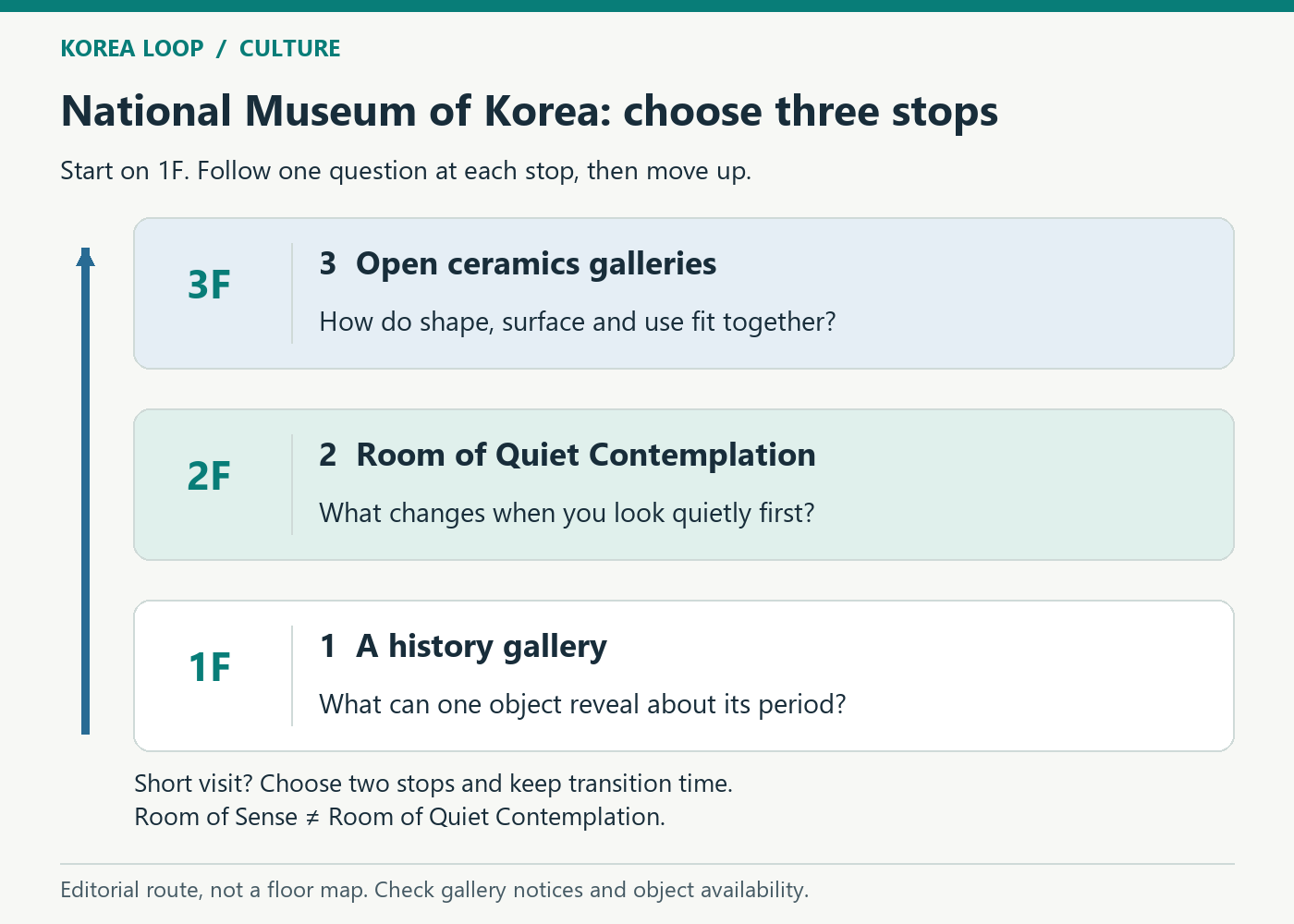
Three stops with a different question at each
| Stop | Look for | Something to think about as you look |
|---|---|---|
| 1F: a history gallery | A small selection from one period | What can an everyday or ceremonial object tell me that a date cannot? |
| 2F: Room of Quiet Contemplation | The two pensive bodhisattva figures | What do I notice if I look quietly before reading the label? |
| 3F: an open ceramics gallery | Celadon or buncheong/white porcelain | How do shape, surface and intended use work together? |
Scroll the table sideways if needed.
The locations follow the museum’s gallery guide. The questions and sequence are our suggestions, not an official tour. Individual objects can rotate; check the current displays if there is a particular object you hope to see.
If you are planning a two-hour visit, you might reserve 30 minutes for the history stop, 20 for Quiet Contemplation, 30 for ceramics and 40 for moving between floors, reading, facilities and a pause. This is a suggested time allowance, not a route we have timed in person. If you have one hour, choose two stops so you still have time to move between them without rushing.
Check the 2026 gallery closures before you go
A museum notice dated 15 June 2026 lists gallery works extending to 28 January 2027. Affected spaces include 301 Buddhist Sculpture, 302 Metal Crafts and the Room of Sense, plus several second-floor galleries. Rooms 303 Celadon and 304 Buncheong and White Porcelain remain available under that notice.
The Room of Sense is not the Room of Quiet Contemplation. Do not remove the latter from your plan merely because the names sound related. Also avoid treating the works as a closure of the whole third floor. Check the latest notices on your visit date in case the programme changes.
Use the closing time to set your arrival time
Current regular hours are 09:30–17:30 on Monday, Tuesday, Thursday, Friday and Sunday, and 09:30–21:00 on Wednesday and Saturday; entry ends 30 minutes before closing. The same visitor page lists 25 September 2026 as the Chuseok closure and quarterly exhibition closures. Check the calendar before making this your rainy-day plan.
If you arrive close to last admission, think about how much time you will have to enjoy the displays after entering. Choose one gallery you care about and save the rest for another visit if you can. You do not need to cover all floors to make a short visit worthwhile.
Make arrival and getting around easier
Read the museum’s current bag and photography instructions before arrival. Allow time for the entrance process and use the indicated storage when required. Decide which bag contents you actually need in the galleries so that a locker stop does not turn into repacking your whole day.
The official museum site links English and Japanese guidebooks. Use the available guide for labels and orientation, but do not infer that every tour or audio product is offered in both languages at every time.
At the end of each stop, note one object or question you would like to remember. A small note can help you remember what caught your attention when you look back on the visit. For the rest of a Seoul itinerary, our flexible three-day guide can help you leave this museum enough space in the day.
Sources checked: 8 September 2026. This guide draws on published sources. The planning examples are our suggestions; this is not a firsthand account of a visit or meal.
Keep exploring
Where to next?
Your First Templestay in Korea: Finding the Right Program
Compare day, experience-oriented and rest-oriented Templestay programs, then confirm language, rooms, participation needs and booking terms with the temple.
Read guideGyeongbokgung in Hanbok: Free Admission Rules Before You Rent
Check Gyeongbokgung’s hanbok admission rules, your normal ticket cost, opening day and rental extras before choosing an outfit.
Read guide
Visiting Korea’s Palaces, Hanok Neighborhoods, and Museums with Care
Get more from Korean cultural sites with practical tips for palace visits, residential hanok lanes, museum galleries, photos, and a comfortable pace.
Read guide