For your first Templestay, start by thinking about the activities you would enjoy. Decide whether you want a short introduction, an organised overnight experience, or a quieter stay with fewer scheduled activities. Once a programme catches your interest, read its listing for the activities, room arrangements and languages available.
Look for a programme whose routine you can comfortably follow. You will be joining life at a temple, so its activities and expectations matter as much as the room and surroundings.
Three types of stay and seven things to check
The official programme directory separates experience-oriented, rest-oriented and one-day options. It also provides a foreign-visitor filter. The filter helps you narrow the search, but you will still need to check which language your session uses.
| If you want… | Search first for… | Read carefully… |
|---|---|---|
| An introduction without sleeping at the temple | One-day programme | Start time, booking requirement and included activities |
| A structured overnight experience | Experience-oriented programme | The complete schedule and participation expectations |
| More unscheduled time | Rest-oriented programme | Which activities still have fixed times |
Scroll the table sideways if needed.
Look closely at the individual programme
The Myogaksa one-night programme page, which listed dates through 31 December 2026 when we checked, describes activities led in English or with English interpretation, an early schedule and possible shared rooms. Those details apply to this programme; other temples may have different arrangements. It does not establish Japanese-language support.
For a different format, Bongeunsa’s 2026 BONGPASS listing describes a Tuesday daytime programme with its own hours and participation details. Check booking requirements for the programme you want. The existence of a day programme does not mean every temple accepts participants without a booking.
Compare those examples only if their actual dates and contents suit you. Choose a programme that fits your schedule, language needs and comfort with the daily routine, even if another temple is better known.
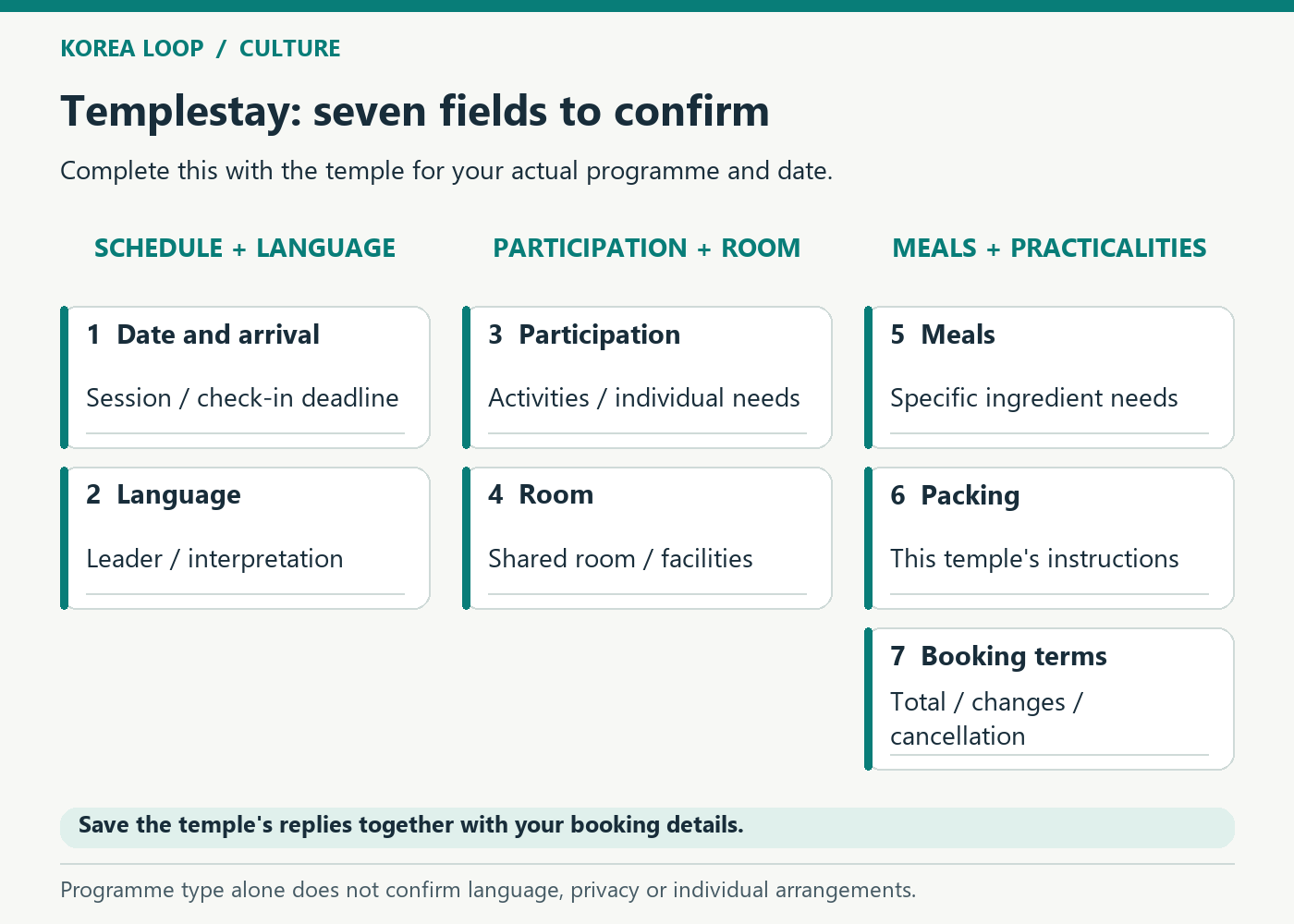
Seven things to confirm before paying
- Date and arrival. Confirm the session date, check-in deadline and what happens if transport is delayed. Leave time between intercity arrival and the programme start.
- Language. Ask what language the person leading your session will use, and whether interpretation or written instructions are available. An English booking page alone does not answer this.
- Participation. Read the full activity schedule. Ask ahead about any movement, early start or ceremony you may find difficult.
- Sleeping arrangements. Confirm whether a room is shared, whether your travelling party can stay together and which facilities are shared. A room photograph alone will not tell you whether you will have it to yourself.
- Meals and individual needs. Explain any ingredient restriction specifically. Ask what goes into the meals; the label “temple food” alone cannot confirm that they meet your needs.
- What to bring. Check clothing, socks, personal items and the programme’s packing instructions. Keep your list tied to that temple.
- Payment, changes and cancellation. Confirm the total, the applicable deadline and the contact responsible for changes. Save the terms attached to your booking.
A message you can adapt
English: “I would like to join [programme] on [date] with [number] people. What language will the activities use? Is the room shared? I need to ask about [specific need]. Please confirm the arrival time, total price and cancellation terms.”
Korean: “[날짜]에 [인원]명이 [프로그램명]에 참가하고 싶습니다. 프로그램은 어떤 언어로 진행되나요? 방을 다른 참가자와 함께 쓰나요? [확인할 사항]에 대해 문의드립니다. 도착 시간, 총금액, 취소 조건도 알려 주세요.”
Replace the brackets with your details and ask clearly about anything you still need to know. If an answer does not resolve a requirement you cannot compromise on, choose another programme before paying. Silence is not confirmation that a request can be accommodated.
Save your booking details and prepare for the stay
The official FAQ notes that confirmation-email practices vary. Keep the temple name, programme date, booking name and temple contact together, even if a message has not arrived. Contact the temple or Templestay support about a booking change rather than assuming an unanswered request has changed the reservation.
During the stay, follow the staff’s instructions about activities and shared spaces. Ask before photographing people or joining an activity late. If participation becomes difficult, tell the staff so they know why you need to miss a scheduled session. For broader etiquette outside the programme, read our guide to considerate cultural visits.
Sources checked: 8 September 2026. This guide draws on published sources. The planning examples are our suggestions; this is not a firsthand account of a visit or meal.
Keep exploring
Where to next?
Gyeongbokgung in Hanbok: Free Admission Rules Before You Rent
Check Gyeongbokgung’s hanbok admission rules, your normal ticket cost, opening day and rental extras before choosing an outfit.
Read guide
Visiting Korea’s Palaces, Hanok Neighborhoods, and Museums with Care
Get more from Korean cultural sites with practical tips for palace visits, residential hanok lanes, museum galleries, photos, and a comfortable pace.
Read guideSeongsan Ilchulbong Without the Climb: Coast and Summit Options
Choose between Seongsan Ilchulbong’s free coastal area and paid summit climb, with practical checks for stairs, weather, opening times and the journey back.
Read guide