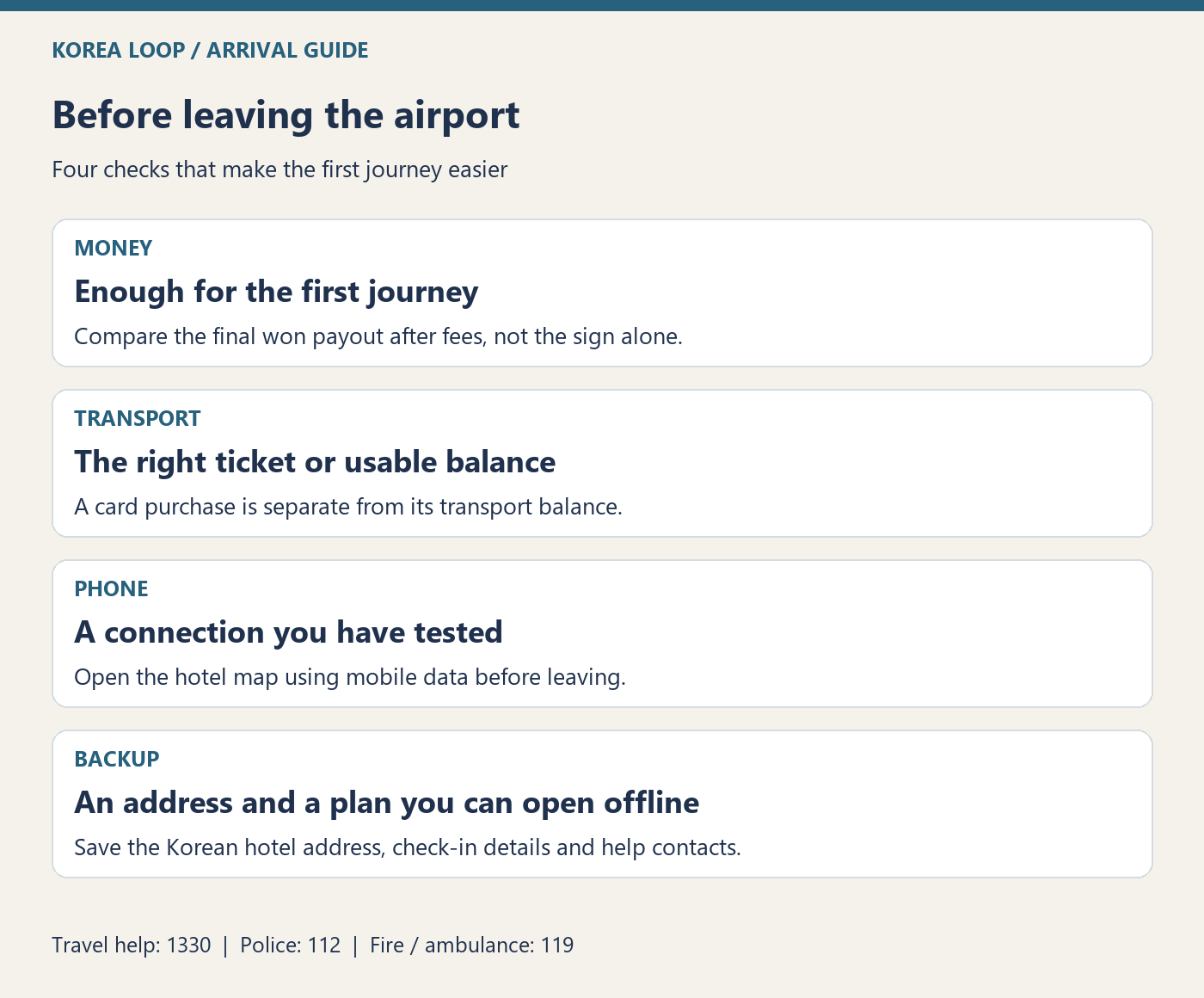
Before leaving Incheon Airport, make sure you can pay for your transfer, open your hotel address and contact the accommodation if plans change. You do not need to exchange your whole budget or buy every tourist card at arrivals. Set up the essentials first, then compare other options when you are rested.
This Seoul arrival checklist covers currency exchange, ATMs, transport cards, mobile data and a few practical details that are easy to miss. For the actual journey, use our Incheon Airport transport and taxi phrase guide.
Currency exchange at Incheon Airport: start with the right terminal
Bank branches, staffed exchange counters and ATMs are different services, sometimes with different opening hours. Also check whether a location is in the public area or beyond immigration/security. A counter you passed inside baggage claim may no longer be accessible after you exit.
| Terminal | Where to look | Before going |
|---|---|---|
| T1 | Woori Bank currency exchange, 1F near Exit 6 | The airport directory lists this counter as 24-hour; recheck the current listing. |
| T2 | Woori Bank 1st Floor Exchange Center, near Exit 7 | The official contact listing gives 032-743-2050. Confirm its hours for your arrival. |
Locations checked September 20, 2026 using the airport’s facilities directory and service contact list. Select your terminal in the directory. These are useful starting points, not a claim that either counter has the best rate.
Bring your passport and ask whether your currency and banknotes are accepted before handing anything over. Keep the receipt and count the won at the counter. If you arrive late, having enough money for transport and the first meal may matter more than finding a marginally better rate elsewhere.
What about exchange offices in Myeongdong?
If you are already staying or sightseeing there, compare nearby exchange counters during their business hours. There is no permanently cheapest shop for every currency and amount. Ask for the final Korean won you will receive for the same foreign-currency amount, after any fees. A large sign or a favorable-looking headline rate is not the whole calculation.
Use this question: 이 금액을 바꾸면 수수료를 빼고 원화로 얼마를 받나요? — “If I exchange this amount, how many won will I receive after fees?” Show the amount and currency on your phone. Do not assume a Japanese-yen rate displayed per 100 yen can be compared directly with a US-dollar rate displayed per dollar.
As a hypothetical comparison, suppose one counter offers ₩100,000 and another ₩102,000 for exactly the same notes. The difference is ₩2,000. Subtract any extra transport cost before making a special trip. These are invented numbers to explain the decision, not live exchange rates. The tourism organization’s airport banking guide is a useful reference for bank services; get an actual quote at the time of exchange.
ATMs and foreign cards: check the total, not just the exchange rate
Before travel, check that your bank allows overseas withdrawals, that you know your PIN, and what fees and daily limits apply. Look for an ATM displaying your card network’s logo. A machine being open does not guarantee that it accepts your particular card. Visa’s travel-support checklist
If a terminal or ATM offers to charge you in your home currency, it is offering its own conversion, often called dynamic currency conversion (DCC). Read the rate and fees. Choosing KRW avoids accepting that offered home-currency conversion, but your own bank’s fees may still apply. Visa explains that travelers should be shown a choice and the relevant conversion information. Visa’s DCC explanation
Keep a backup payment method separately from your main wallet. Test your main card with a modest purchase before relying on it for the whole trip, and retain enough cash for a situation where the terminal or card fails. There is no single cash budget that suits every traveler.
Tmoney, tourist cards and the balance you can actually spend
A physical Tmoney or EZL card is a straightforward option for ordinary public transport. VISITKOREA lists convenience stores as places to buy and reload them. The card purchase and its stored travel balance are separate: check how much usable balance it has before boarding. For children or teenagers, ask about registering the passenger’s date of birth for the applicable fare. Official transport-card guide
Keep some won available for top-ups. Reload methods vary by card, device and sales channel; do not assume your overseas bank card will work at every machine. A physical card is also a useful fallback if you have not checked whether your phone’s transit-card feature works with your device and payment card.
Use one transport card per traveler as the simple default. Tap it at subway entry and exit gates, and when boarding and leaving city buses. For an airport coach, follow that operator’s ticket instructions instead of assuming ordinary city-bus rules apply.
Before buying a tourist payment card or unlimited pass, check four things: purchase cost, covered routes, activation rules and refunds. Ask whether its shopping balance and transport balance are separate. Do not assume a city pass covers the airport journey, or that a transport-card balance pays for AREX Express; Express uses a separate ticket.
SIM or eSIM: make the map work before you leave the counter
- Check device compatibility and carrier lock. Your phone must support the chosen SIM or eSIM and allow another operator’s service. On iPhone, Apple explains how to check the Carrier Lock field in Settings. Apple’s international eSIM guide
- Decide whether you need only data or also calls. Ask about outgoing calls, SMS, hotspot use and when the validity period starts. A plan’s local phone number does not by itself promise access to every identity-verification service.
- Test the connection before walking away. Open the hotel map and a fresh webpage using mobile data. Keep activation instructions and the provider’s support details offline.
- Check your home line’s settings. Select the intended data line and review roaming settings with your providers to avoid accidental charges.
The airport’s service directory lists KT, SK Telecom and LG U+ counters by terminal. Compare the service you need rather than buying solely because a booth advertises a discount. KT’s tourist eSIM information, for example, distinguishes data and voice options; provider terms and device support need checking individually.
Save your hotel’s Korean address, the chosen station or bus stop, the final walk, and check-in instructions as screenshots. Try a local map app such as NAVER Map or KakaoMap before the trip and see which language options work for you. Offline address screenshots remain useful even if an app cannot load a route.
The small details that prevent a difficult first day
- Luggage before sightseeing: ask your hotel whether it accepts bags before check-in. If using a storage service, check suitcase size, opening hours and the latest collection time. Never assume lockers will have space.
- Late check-in: save the hotel’s phone number and any door-entry instructions. A prepaid room and a staffed reception are different things.
- Power: Korea uses 220 V, 60 Hz with round-pin outlets. Check your device’s input label; a plug adapter changes the plug shape, not the voltage. A charger marked 100–240 V has a different requirement from a 100 V-only appliance. VISITKOREA electricity guide
- Food: if you have an allergy, carry its Korean name and ask about sauces, broth and shared cooking equipment. A dish’s photograph cannot confirm its ingredients. Our Korean BBQ ordering guide helps with portions and ordering questions.
- Return journey: save the departure terminal and airport route while the details are fresh. A convenient arrival route may not run early enough for your return flight.
Useful Korean phrases and help numbers
| Meaning | Korean |
|---|---|
| Please top up this transport card by ₩10,000. | 이 교통카드에 만 원 충전해 주세요. |
| Where is the currency exchange counter? | 환전소가 어디에 있나요? |
| Can you store my luggage before check-in? | 체크인 전에 짐을 맡길 수 있나요? |
| Where is the elevator? | 엘리베이터가 어디에 있나요? |
The ₩10,000 phrase is an example top-up request, not a recommended daily budget. Confirm the amount you want before handing over cash.
For travel information and interpretation, use 1330; VISITKOREA also lists +82-2-1330. For an emergency, call 112 for police or 119 for fire or an ambulance. A data-only plan may not provide ordinary outgoing calls, so save the official 1330 chat as a non-emergency alternative. The tourism organization’s emergency FAQ distinguishes urgent help from tourist inquiries.
Checked September 20, 2026. This is a research-based practical guide, not a claim of personal use or a live exchange-rate comparison. No paid recommendation or affiliate link appears in this article.